

Meet Counsellor Tomass J Wood
Welcome to the World of Counsellor Tomass J. Wood
Welcome to the world of Counsellor Tomass J. Wood — author, psychotherapist, educator and creator of the Tom Tom Universe.
My work begins with something deeply personal: my own childhood.
I grew up neurodivergent, curious, imaginative and constantly questioning the world around me, but without the words to explain why I experienced that world differently. My childhood also included abuse, difficult experiences and times when I desperately needed adults to understand what was happening beneath my behaviour rather than simply seeing the behaviour itself.
Those experiences now sit at the heart of my writing.
Through the Tom Tom Book Series, I revisit genuine childhood memories and transform them into warm, hopeful stories about curiosity, mistakes, friendship, family, music, fear, sensory experiences, belonging and growing up neurodivergent. Tom Tom is inspired by the child I once was — and, in many ways, the stories give that little boy some of the understanding and language I wish he had possessed.
At the centre of the Tom Tom Universe are my Four Pillars: Brian’s, Waves, Circles and Bridges. They give children a simple language for understanding their thoughts, emotions, familiar sources of safety and the people or strategies that can help them move forward when life becomes difficult.
But my work reaches far beyond children's stories.
I am building a growing collection of educational resources, Special Learners books, Functional Skills materials, emotional-development tools and self-help guides, particularly for people whose minds do not always fit comfortably within conventional systems of learning.
That matters personally to me. I struggled within traditional education myself and found another route into learning. It taught me something I have carried throughout my life:
Struggling with the path does not mean you are incapable of reaching the destination. Sometimes you simply need a different bridge.
Alongside the Tom Tom Universe, I write Young Adult fiction, where I explore much more difficult subjects including childhood trauma, abuse, coercive control, memory, identity, survival and what happens when home is not the safe place a young person needs it to be. Even within my darkest stories, however, I remain interested in possibility — in what happens when somebody is finally heard, finds a way forward or discovers that their past does not have to dictate their entire future.
Everything I create is connected by the same curiosity that has followed me since childhood.
Why do we think the way we do?
Why do we feel the way we do?
What is behaviour trying to communicate?
How do we learn differently?
What helps somebody feel safe?
And what bridge might help them reach somewhere they could not reach alone?
Welcome to my world.
A world of stories, psychology, education, neurodivergence, difficult questions, enormous imagination and, above all, hope.
Welcome to the world of Tomass J. Wood.
Small Stories. Big Feelings. Brighter Tomorrows.
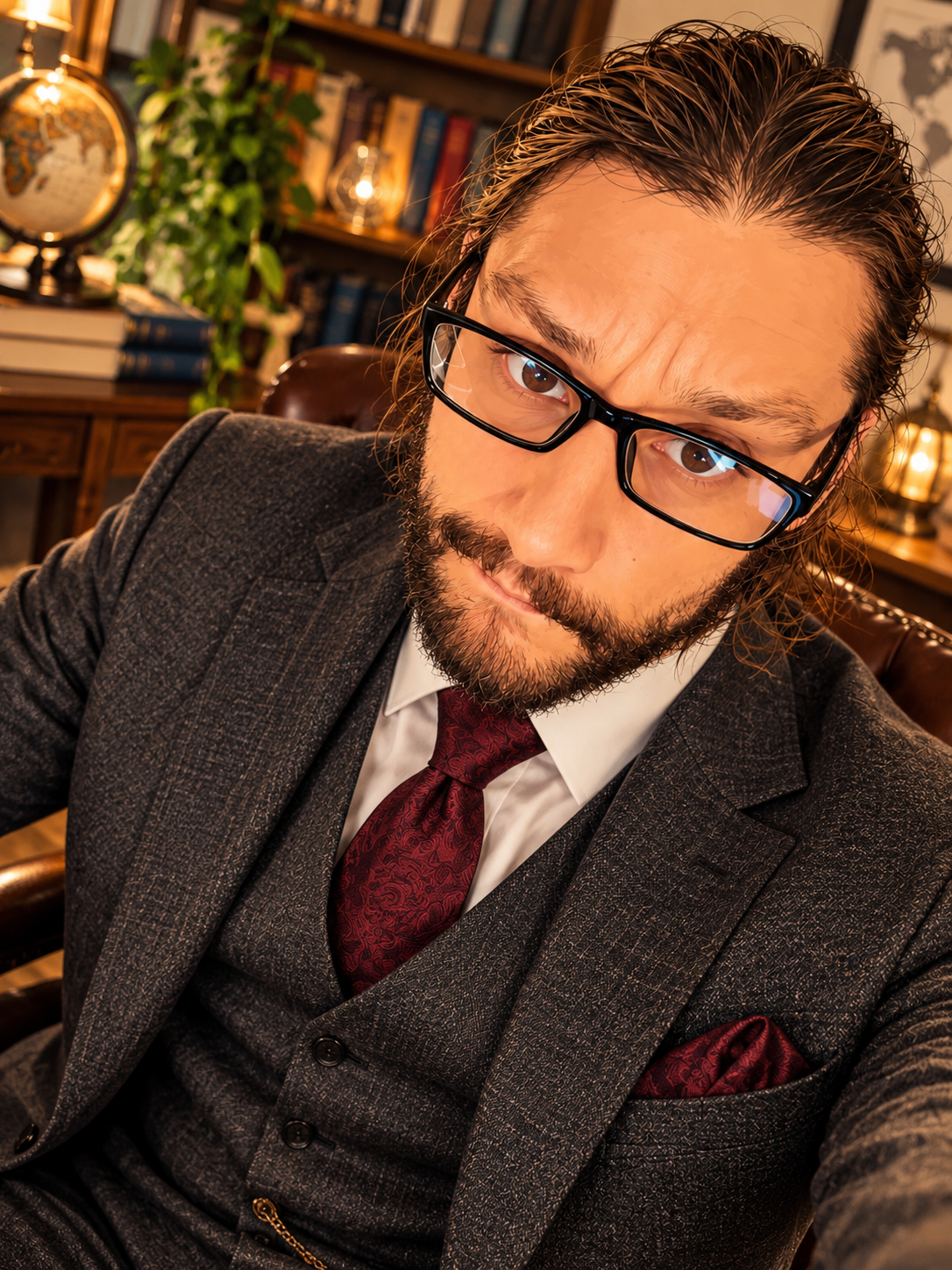
What makes Tomass J Wood different?
Counsellor Tomass J. Wood — Author, Educator and Creator of the Tom Tom Universe
I am Counsellor Tomass J. Wood, a psychotherapist, hypnotherapist, counsellor in mental health, neurodivergent writer and creator of the Tom Tom Universe.
My writing comes from an unusual meeting point: lived experience, neurodivergence, psychology, education, imagination and childhood memory.
I am AuDHD — autistic and ADHD — and I also experience rejection sensitivity and social anxiety disorder. I did not grow up with the language to understand those parts of myself. I simply knew that I experienced the world differently. I questioned things constantly. I could become intensely absorbed in subjects that fascinated me. My imagination could disappear down enormous rabbit holes, while situations that seemed ordinary to other people could feel overwhelming to me.
My childhood was also affected by abuse and difficult experiences. That history inevitably influences the writer I have become.
I cannot rewrite my own childhood, but through fiction I can sometimes explore the stories I wish children like me had been given: stories in which a frightened child is understood; behaviour is looked beneath rather than merely punished; adults listen; feelings are given names; difference is not treated as failure; and difficult experiences can lead somewhere hopeful.
That does not mean pretending difficult things do not happen.
Some of my writing goes directly into uncomfortable territory.
What interests me is what happens inside a human being when they experience those things — and what might help them find a way through.
The Tom Tom Universe
Tom Tom is deeply connected to my own childhood.
Many of his stories grow from genuine experiences, places, interests and people from my life. He is neurodivergent, curious, imaginative and sometimes overwhelmed by a world that does not always operate in the way his brain expects.
But I never wanted Tom Tom simply to become a character who teaches children about diagnoses.
The larger purpose is to give children a language for understanding themselves.
That is where the Four Pillars of the Tom Tom Universe developed:
Brian’s — Waves — Circles — Bridges.
Brian’s — What is happening inside me?
Tom Tom imagines different parts of his thinking and emotional world as his different Brian’s.
There might be Curious Brian, Questioning Brian, Imagination Brian, Worry Brian, Sensitive Brian, Safety Brian, Learning Brian, Comfort Brian, Hope Brian, Kindness Brian, Fear Brain, Freeze Brain or Guilt Brain.
They are not separate personalities and they are not intended as clinical labels.
They are a child-friendly way of saying:
“There are lots of things happening inside my mind at once.”
Rather than asking only, “Why did you behave like that?”, I want children and adults to become curious:
Which Brian was talking?
What was the child frightened of?
What were they trying to understand?
What were they trying to communicate?
What did their brain believe it needed?
Waves — How big is this feeling?
Emotions move.
They rise and fall.
So Tom Tom experiences them as Waves.
A Small Wave might be something he can comfortably manage.
A Medium Wave tells him something is beginning to build.
A Big Wave tells us he needs support, space or change.
A Storm means everything has become too much.
Importantly, Waves are not simply negative emotions.
Excitement can create a Big Wave.
Joy can create a Big Wave.
Music can.
Love can.
Noise can.
Fear can.
The question is not whether the Wave is good or bad.
The question is:
“What is Tom Tom's brain and body experiencing?”
Circles — What helps me feel safe?
Circles are the familiar things that come around again.
Routine.
Predictability.
A person.
An object.
A song.
A place.
A special interest.
Knowing what happens next.
For Tom Tom, even his beloved Pound Pups can become Circles.
I do not see these things as weaknesses that children must automatically be trained away from. A Circle can provide enough safety for a child to explore something beyond it.
That changes the question from:
“How do we make this child cope like everybody else?”
to:
“What helps this child feel safe enough to participate?”
Bridges — How do I get from here to there?
Sometimes Tom Tom wants to do something but cannot reach it in the expected way.
That is where Bridges come in.
A Bridge might be another person.
It might be preparation, communication, music, a picture, a special interest, an object, reassurance, a different route or simply somebody taking the time to understand.
The destination does not necessarily have to change.
The route can.
That idea sits at the centre of much of my educational philosophy.
If a child cannot cross the bridge we built for them, perhaps our first response should not be to blame the child.
Perhaps we need to build another bridge.
Stories Built From Childhood
The introductory books establish these ideas through stories rather than lectures.
Meet Tom Tom introduces Tom Tom, his family, his Pound Pups and the Four Pillars through a family trip to Ringwood Carnival.
Then there is my starter trilogy, drawn strongly from my early experiences:
Tom Tom, the Fire, and the Special Pound Puppy explores childhood curiosity, an accidental house fire, fear, guilt, safety, forgiveness and the extraordinary emotional importance a comfort object can hold for a child.
Tom Tom and the Music Box explores my early relationship with music, St Thomas Church, Mrs Matthews, the vicar's cottage, a baby grand piano and the discovery that music could become both fascination and connection.
Tom Tom and the Marching Bands follows that musical thread into the Boys' Brigade, East Dorset Scout Band, Dolphin Marching Band, Ringwood Carnival and the growing discovery that music could offer structure, identity and belonging.
These are children's stories, but underneath them is a much larger question:
What happens when we look at childhood through the child's eyes rather than exclusively through adult interpretations of behaviour?
Education and the Special Learner
My educational writing comes from personal experience too.
I struggled with the conventional GCSE pathway. I was fortunate to gain access to college through a pilot scheme intended to provide another route for young people who struggled within the usual academic system. I achieved my first City & Guilds qualification at fifteen.
That alternative route became a gateway rather than a dead end.
It profoundly influences how I think about education.
A learner struggling with one educational pathway is not necessarily incapable of learning.
Sometimes the pathway is wrong.
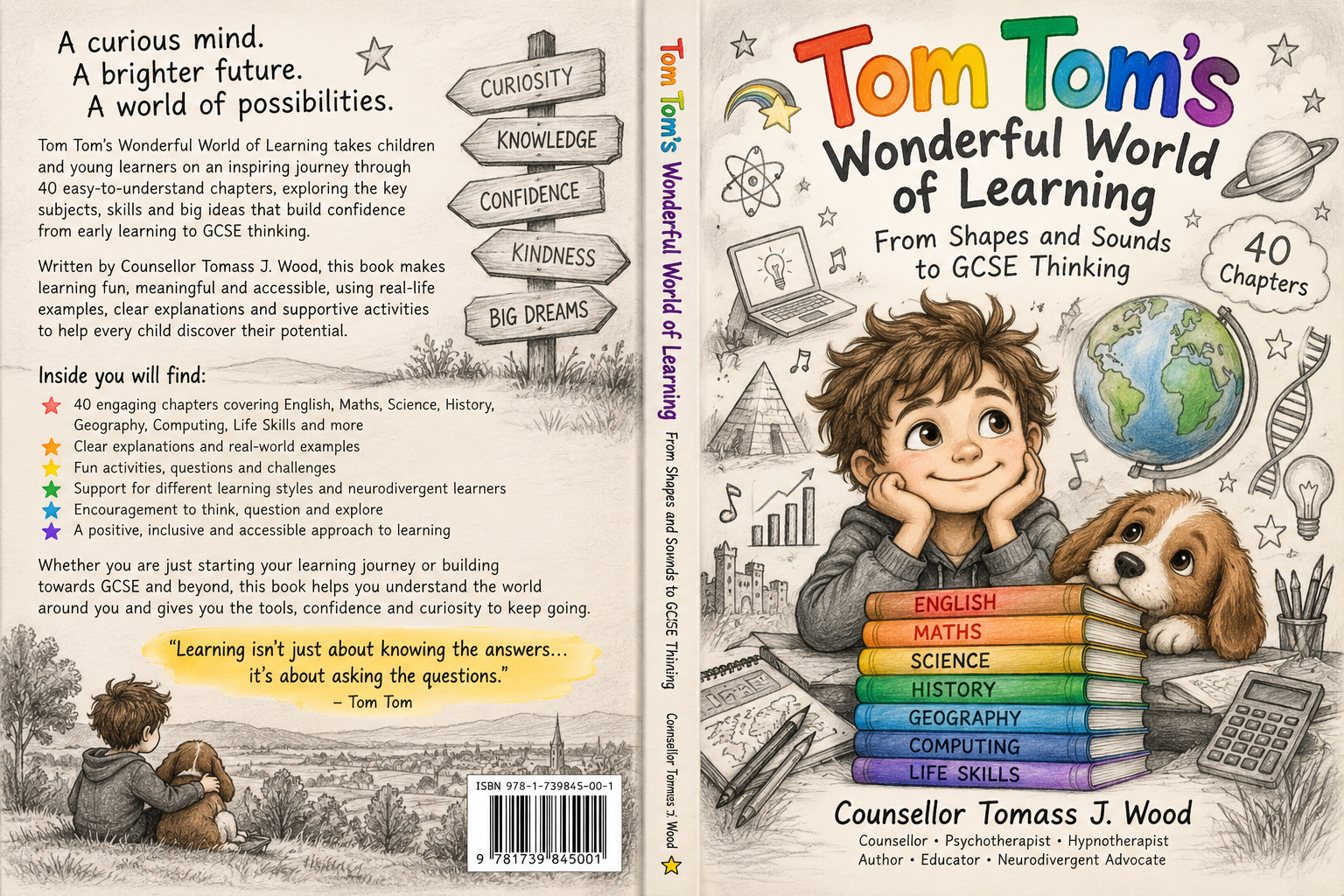
This philosophy led to books including Tom Tom's Wonderful World of Learning and the Tom Tom's Special Learners Functional Skills material.
I want to build resources that move from curiosity and foundational learning towards practical qualifications and real opportunities.
The ambition is not to lower expectations for neurodivergent children.
It is almost the opposite.
Keep the destination ambitious while becoming more imaginative about the route.
That is Bridges applied to education.
Beyond Tom Tom — My YA Writing
My writing becomes considerably darker as its intended readership grows.
My YA and crossover fiction allows me to investigate memory, abuse, coercive control, trauma, identity, exploitation, family, survival, time and the consequences of the choices adults make around children.
Books and series I have developed include The Memory Shop, The Children of the Quantock, The Boy Who Stole Tomorrow, The Key to Yesterday, The House That Forgot Us, The House That Remembered, The Boy Who Ran, The Thought Thieves, The Eventide, as well as larger speculative projects exploring space and Mars.
The genres change.
The underlying fascination often does not.
What makes somebody who they are?
What does memory do to identity?
What happens when home is not safe?
How does a young person survive coercion or abuse?
What do we carry from childhood into adulthood?
Can someone break a pattern they inherited?
And what happens when somebody finally has a choice?
My experience as a survivor of childhood abuse inevitably informs some of those questions.
I do not want abuse to exist in a story merely for shock.
I am interested in its human consequences: fear, secrecy, loyalty, shame, memory, survival and the complicated process of discovering that another life may be possible.
Sometimes fiction allows me to create the intervention, understanding, protection or hopeful outcome that I wish had existed in parts of my own childhood.
That is not about pretending the past was different.
It is about asking what the future could be.
Curiosity Is Part of My Writing
My curiosity also extends well beyond conventional fiction.
I can become fascinated by music, psychology, consciousness, space, time, waves, particles and questions raised by experiments such as the double-slit experiment.
I enjoy the rabbit hole.
I enjoy asking “What if?”
Not every idea I explore is intended to be presented as established science. Sometimes the value is in the thought experiment itself — following an idea, testing where it breaks, asking another question and allowing curiosity to generate creativity.
That same Curious Brian who exists in Tom Tom exists in the way I write.
It can produce a children's story one day, a psychological YA novel the next and a page of questions about time, light and reality afterwards.
To me, those things are connected by curiosity.
What I Want My Writing to Achieve
I don't want the Tom Tom Universe simply to tell children that it is okay to be different.
I want to give them tools for understanding what that difference feels like from inside.
I want a child to be able to say:
“My Worry Brian is loud.”
“I'm having a Big Wave.”
“I need my Circle.”
“Can you help me build a Bridge?”
Those are simple phrases.
But behind them are substantial ideas about emotional literacy, communication, regulation, predictability, adaptation and compassionate curiosity.
I also want adults to become curious before becoming judgemental.
Instead of immediately asking:
“How do we stop this behaviour?”
I want us sometimes to ask:
“What is this behaviour communicating?”
Understanding behaviour does not mean abandoning boundaries, safety or responsibility.
Tom Tom can make mistakes.
He can get things wrong.
He can learn.
But learning should not require a child to believe that they themselves are the problem.
The Writer I Am Becoming
I write across children's fiction, educational material, emotional-development resources, YA fiction and speculative ideas because my mind has never stayed comfortably inside one box.
I no longer think it needs to.
The child who questioned everything became a counsellor.
The child who escaped into imagination became a novelist.
The learner who struggled with the expected educational route became someone designing alternative routes for other learners.
And the child who experienced abuse became an adult trying to create stories in which children are listened to, understood and given language for things they may not yet know how to explain.
That, ultimately, is what connects my work.
Curiosity without shame.
Education without assuming there is only one road.
Emotional understanding without judgement.
Difficult stories without abandoning hope.
And childhood viewed not simply as something adults manage, but as a rich internal world deserving to be heard.
That is what I want the Tom Tom Universe, my educational work and my novels to stand for.
Small Stories.
Big Feelings.
Brighter Tomorrows.
Counsellor Tomass J. Wood
Psychotherapist / Hypnotherapist / Counsellor in Mental Health
The message behind the work
The most important thing I want people to understand is this: you matter. Your story matters. And you are capable of learning, growing, and becoming more than you ever imagined. I believe that many people struggle not because they lack ability, but because they have not always had the right support, explanation, or opportunity.
Sometimes people need someone to say: "Let me explain it another way." "Your feelings make sense." "You are not alone." "You can learn this." That simple moment of understanding can change someone's direction. Before people can grow, they need to feel understood. My books are created to make knowledge more accessible and practical.
Who Tomass J Wood helps
Counsellor Tomass J Wood’s work is created for people who may be looking for understanding, guidance, confidence, and practical tools to help them navigate life. His books and counselling approach are designed to support people at different stages of their journey — from childhood through adulthood.
🌈 Children finding their place in the world
The Tom Tom series supports children who are learning who they are, how to understand their feelings, how to build friendships, how to communicate, how to handle challenges, and how to recognise their strengths. These books are especially focused on helping children feel: "I belong. I am understood. I can grow."
💙 Parents, families, and carers
The parenting collection supports adults who want to better understand the children in their lives. It explores building stronger relationships and supporting emotional development.
“Tomass’s work is deeply personal, compassionate and refreshingly different. Drawing on lived experience, neurodivergence, counselling and education, he has a remarkable ability to turn complex emotions and ideas into something accessible and meaningful. His stories and resources do more than teach — they encourage people to understand themselves, recognise their needs and discover that there can be more than one path forward.”
A satisfied reader