

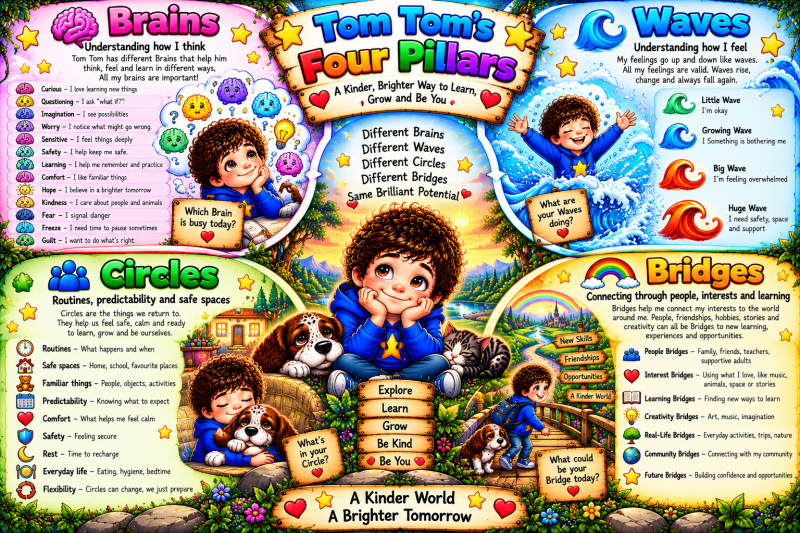
Tom Tom’s four pillars
A simple, shared language to help children and families understand thoughts, emotions, routines, and learning together at home.
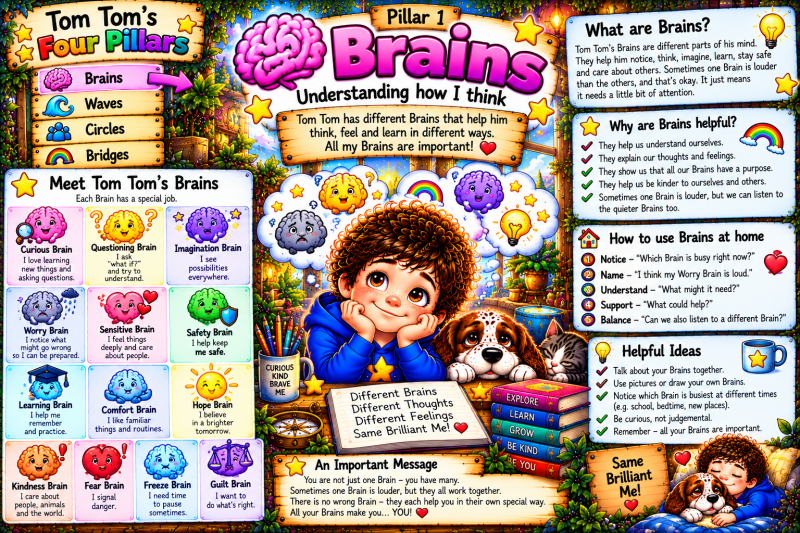
1. Brains: understanding how I think
Tom Tom visualises the mind having different Brains — like a Curious Brain, Worry Brain, Imagination Brain, Safety Brain, or Comfort Brain. Separating who children are from what their mind is doing helps replace blame with gentle curiosity: "Which Brain was really loud today?"
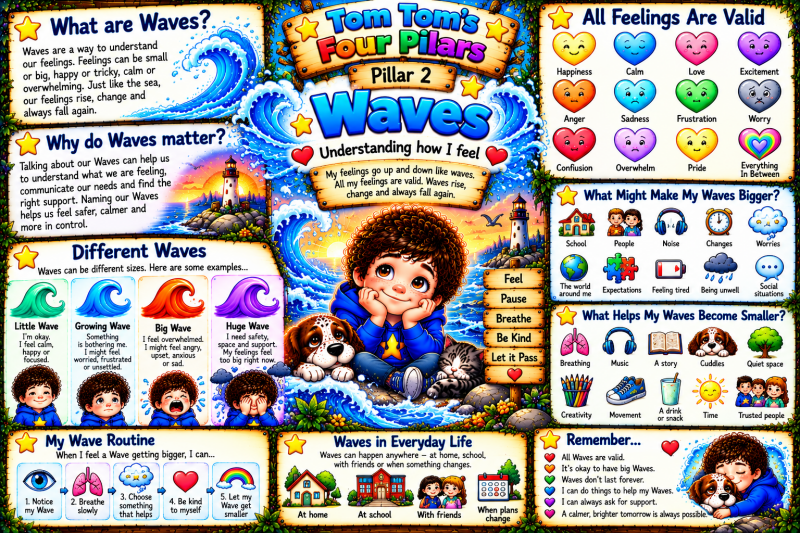
2. Waves: understanding how I feel
Feelings rise, peak, and fall like waves. From tiny ripples to huge surges, Waves give children an intuitive way to express emotional intensity without overwhelming vocabulary. When a Wave is huge, help it settle first before trying to find answers.
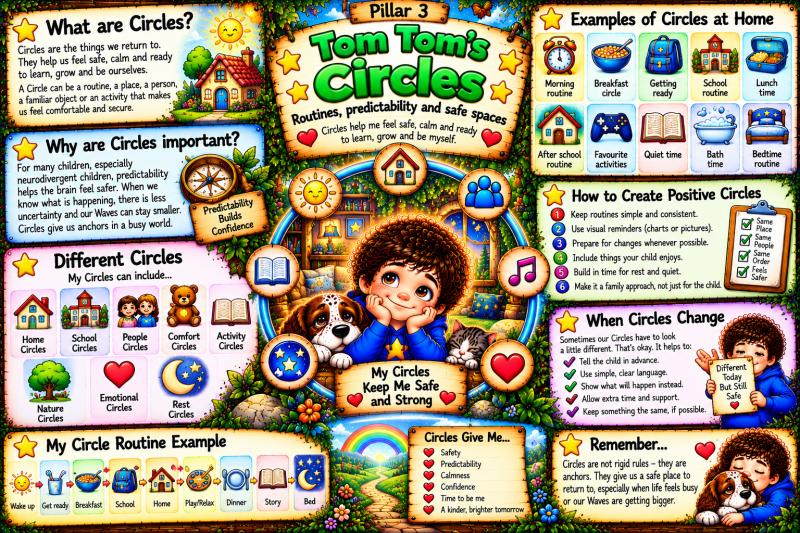
3. Circles: routines and safe spaces
Circles are the predictable anchors we return to — daily rhythms, familiar meals, comforting objects, or quiet decompression time. They reduce uncertainty for neurodivergent minds and offer steady safety when unexpected changes arise.
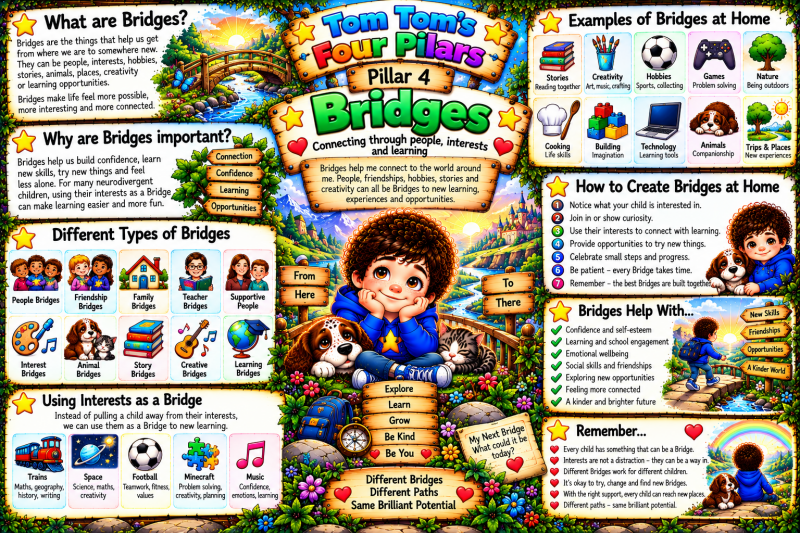
4. Bridges: connecting through passions
A Bridge connects where a child is to somewhere new. Whether it is a deep passion like trains or dinosaurs, or a trusted person walking beside them, special interests aren't obstacles to learning — they are the path into discovery and mutual connection.
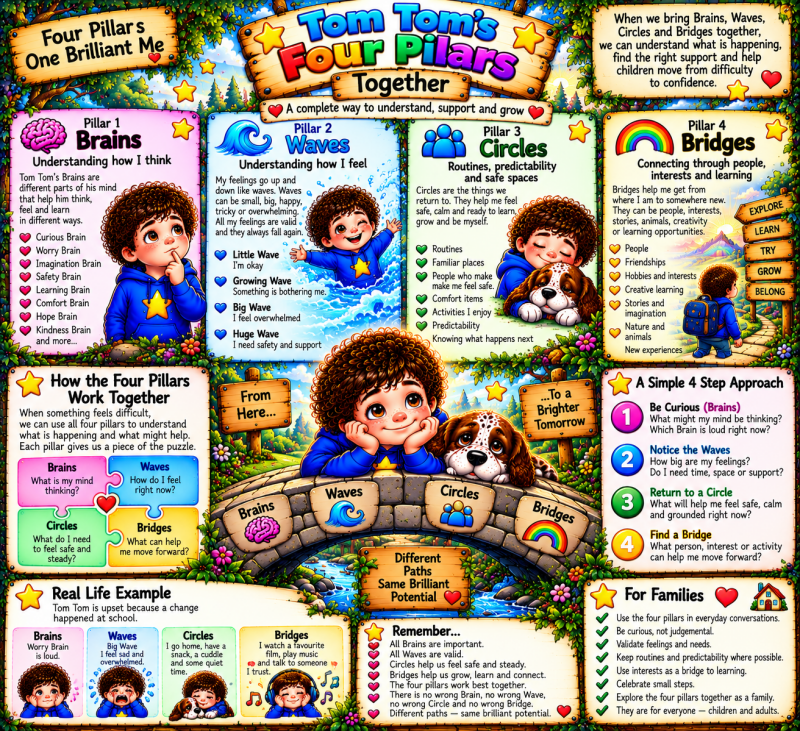
Tom Tom’s Four Pillars
Brains • Waves • Circles • Bridges
A simple way to understand ourselves — and support children at home
The Four Pillars sit at the heart of the Tom Tom Universe. They grew from my own experiences of neurodivergence, alongside my work in counselling and emotional wellbeing.
They are not rules, diagnoses or another system children have to get “right”. They are a shared language that families can use to talk about thoughts, emotions, routines, needs, relationships and learning.
A child might not be able to say, “I am becoming emotionally dysregulated because something unexpected has happened and I need time to process it.”
But they may be able to say:
“My Waves are getting big.”
And sometimes, that little bit of shared language can make a very big difference.
🧠 1. Tom Tom’s Brains
Understanding how I think
Tom Tom talks about his mind as having lots of different Brains.
There might be a Curious Brain asking questions, a Worry Brain imagining what could go wrong, an Imagination Brain creating possibilities, a Safety Brain looking for danger, or a Comfort Brain wanting something familiar.
The idea helps children separate who they are from what their mind is doing at that particular moment.
Instead of:
“I’m naughty.”
We can explore:
“Which Brain was really loud when that happened?”
Using Brains at home
Parents and children can begin noticing their Brains together.
At breakfast, in the car, after school or before bed, try asking:
“Which Brain has been busy today?”
Perhaps Curious Brain appeared during homework. Worry Brain appeared before school. Imagination Brain took over during play. Comfort Brain wanted the same bedtime story again.
There doesn't always need to be a solution.
Sometimes simply noticing the Brain is enough.
🌊 2. Tom Tom’s Waves
Understanding how I feel
Feelings aren't static.
They rise, change and eventually fall — rather like waves.
Some Waves are tiny. Some are exciting. Some feel enormous.
Tom Tom's Waves give children a visual way of communicating emotional intensity without needing complicated emotional vocabulary.
A child might say:
“I've got a big Wave.”
That can become the beginning of a conversation rather than the beginning of an argument.
Using Waves at home
Try asking:
“What are your Waves doing?”
You could even use your hands to show the size.
🤏 Little Wave — I'm okay.
🌊 Growing Wave — something is bothering me.
🌊🌊 Big Wave — I'm struggling.
🌊🌊🌊 Huge Wave — I need safety, space and support.
When a Wave is enormous, that usually isn't the best moment for a lecture or lots of questions.
Help the Wave become smaller first. Understand it afterwards.
🔵 3. Tom Tom’s Circles
Routines, predictability and safe spaces
Circles are the things we return to.
They might be routines, familiar places, favourite objects, repeated activities or people who help us feel secure.
For many neurodivergent children, predictability can reduce the amount of uncertainty their brain has to process.
A Circle might be:
the same morning routine, a familiar breakfast, knowing what happens after school, a bedtime story, a favourite teddy, five quiet minutes after getting home, or knowing beforehand when plans are changing.
Using Circles at home
Create a few dependable family Circles.
A simple evening Circle could be:
Home → snack → quiet time → dinner → bath → story → bed.
Circles shouldn't become rigid rules that make family life impossible.
Think of them as anchors.
And when something has to change, tell the child whenever possible:
“Our Circle is going to look a little different today.”
That gives their brain time to adjust.
🌈 4. Tom Tom’s Bridges
Connecting through people, interests and learning
A Bridge helps us get from where we are to somewhere new.
For Tom Tom, Bridges can be people, friendships, interests, hobbies, music, animals, stories, creativity or subjects he loves.
Instead of constantly trying to pull a child away from their interests, we can sometimes use those interests as a Bridge towards something new.
A child fascinated by trains can explore maths through timetables, geography through railway maps, history through steam engines and writing through creating their own railway adventure.
The interest isn't necessarily getting in the way of learning. It may be the way into learning.
Using Bridges at home
Ask:
“What could be our Bridge?”
If homework feels impossible but your child loves dinosaurs, space, Minecraft, music or animals, bring that interest into the activity.
Bridges can also be people.
Sometimes a child cannot cross something difficult alone — but they can cross it with someone they trust beside them.
❤️ Putting the Four Pillars Together
The real strength of the Four Pillars comes when we stop treating them separately.
Imagine a child comes home from school, throws their bag down and becomes upset.
Instead of beginning with:
“What's wrong with you?”
we can become curious.
🧠 Brains: What might their mind be processing?
🌊 Waves: How big are their feelings right now?
🔵 Circles: Has something familiar changed, or do they need to return to something safe and predictable?
🌈 Bridges: What person, interest or activity could help them reconnect?
Now we're not simply looking at behaviour.
We're looking underneath it.
🏡 Try the Four Pillars Tonight
You don't need worksheets or specialist equipment.
During a quiet moment, ask your child four gentle questions:
- Which Brain has been busiest today?
- What have your Waves been like?
- Which Circle helped you feel safe or comfortable?
- What was your favourite Bridge today — a person, interest, activity or connection?
Parents can answer too.
That matters because the Four Pillars aren't something adults do to children.
They're something families can explore together.
🌟 The Tom Tom Message
The Four Pillars are ultimately about replacing judgement with curiosity.
Instead of only asking:
“How do we stop this behaviour?”
we can also ask:
“What is this behaviour trying to tell us?”
Tom Tom's Brains, Waves, Circles and Bridges give children and adults a shared vocabulary for beginning that conversation.
Different Brains. Different Waves. Different Circles. Different Bridges.
Different paths — same brilliant potential.
The Four Pillars are educational and emotional-wellbeing tools and are not a replacement for individual medical, psychological or professional support when this is needed.