

Research into Quantum Physics
Thinking in waves and interconnected patterns
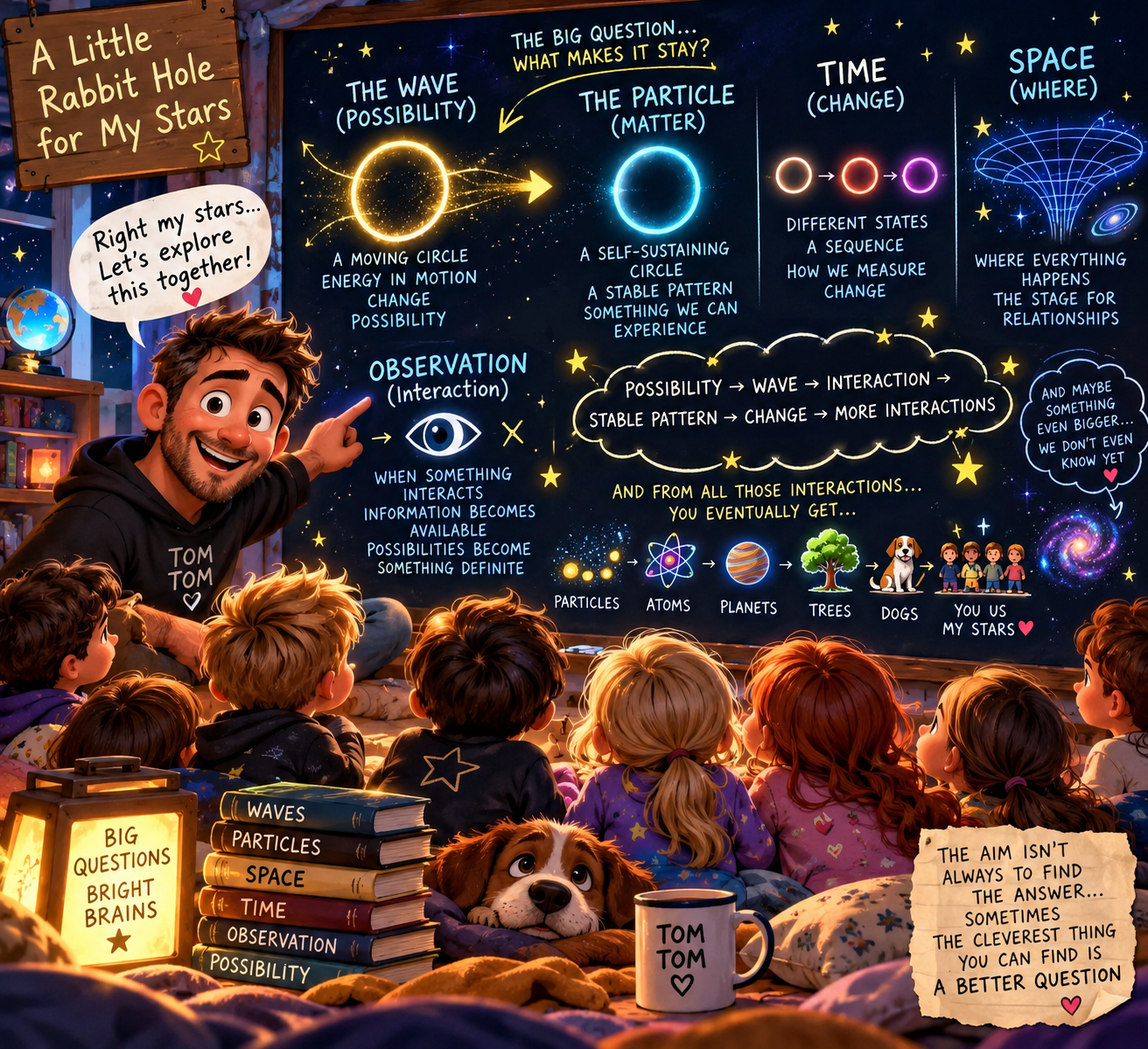
In quantum physics, particles can act like waves—dynamic, spreading, and constantly interacting. In emotional wellbeing, our thoughts and feelings behave in remarkably similar ways. Rather than viewing an emotion as a fixed state, we can observe it as a wave that rises, shifts, and connects to our surroundings. These simple visual analogies offer children, young people, and adults a supportive framework to understand how internal patterns can change over time.
The power of saying “I do not know yet”
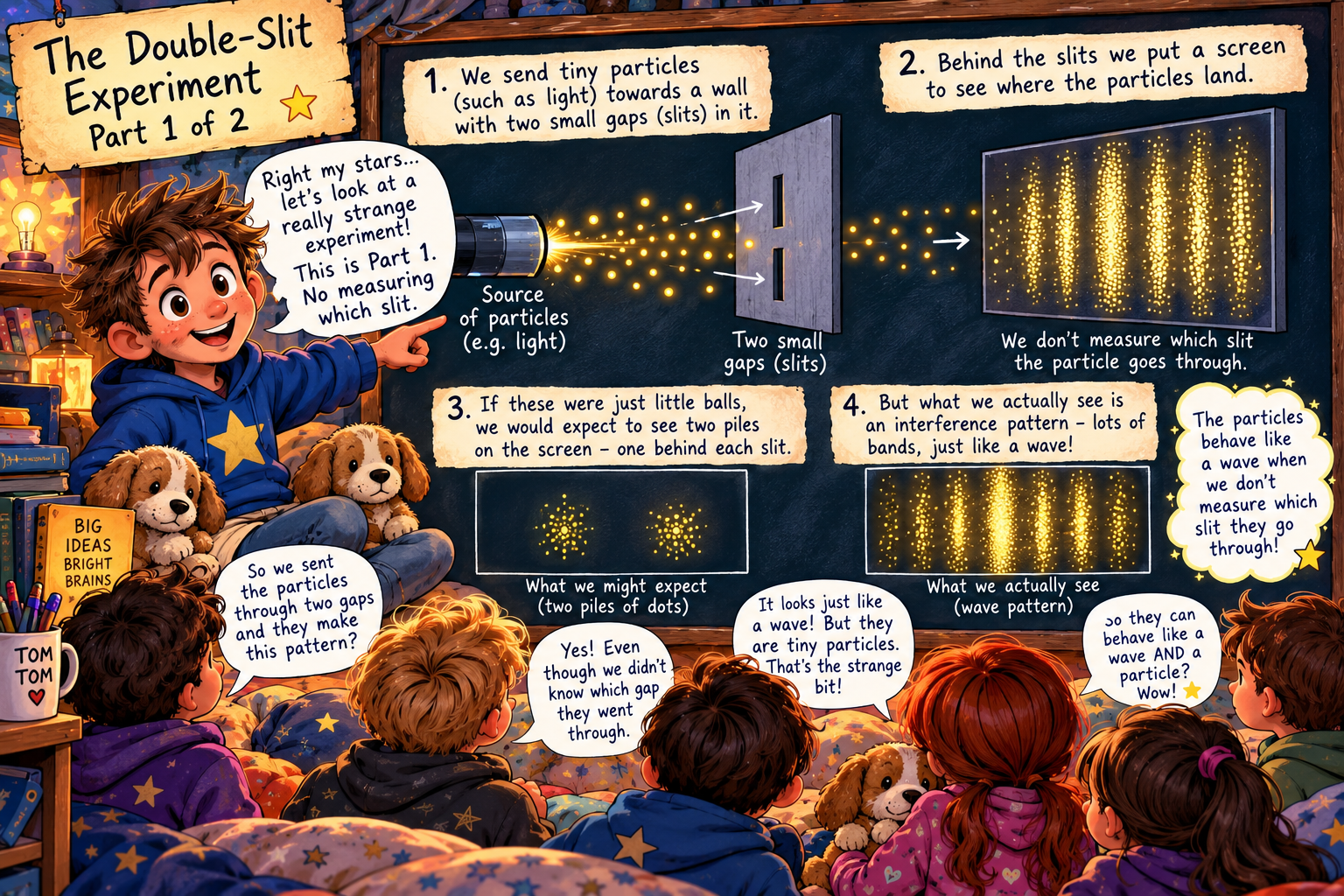
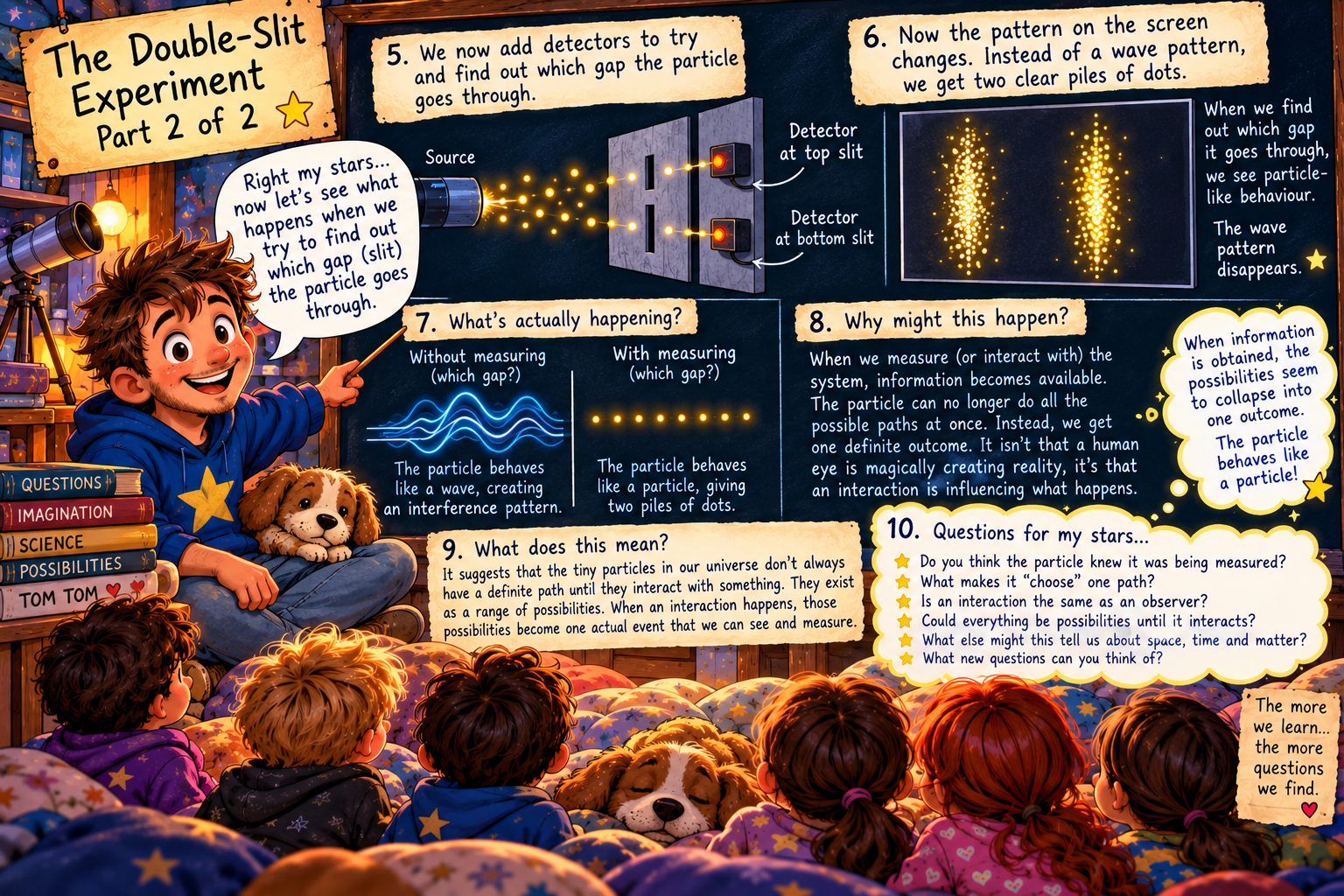
One of the most liberating principles in modern physics is embracing uncertainty. In both science and counselling, not knowing the answer is not a failure—it is the very beginning of genuine learning. Within the Tom Tom Book Series, young thinkers are encouraged to experiment, challenge assumptions, and stay curious. Neurodivergent minds frequently thrive when given permission to explore the unknown without the pressure of instant answers.
Neurodivergent inquiry as a creative superpower
An inquisitive mind that questions everything is an extraordinary tool for creativity and self-understanding. By linking therapeutic reflection with curiosity about the cosmos, we open meaningful discussions for families, educators, and young people. We invite you to explore the Tom Tom Universe, delve into our books, and bring your own big questions to life.
My Quantum Physics Research: Waves, Particles and Curiosity
My interest in quantum physics began with the double-slit experiment. It shows how tiny objects such as photons and electrons can produce wave-like interference patterns, while being detected as individual events. It challenged my everyday ideas about what a particle is, what a wave represents and what happens when we measure something.
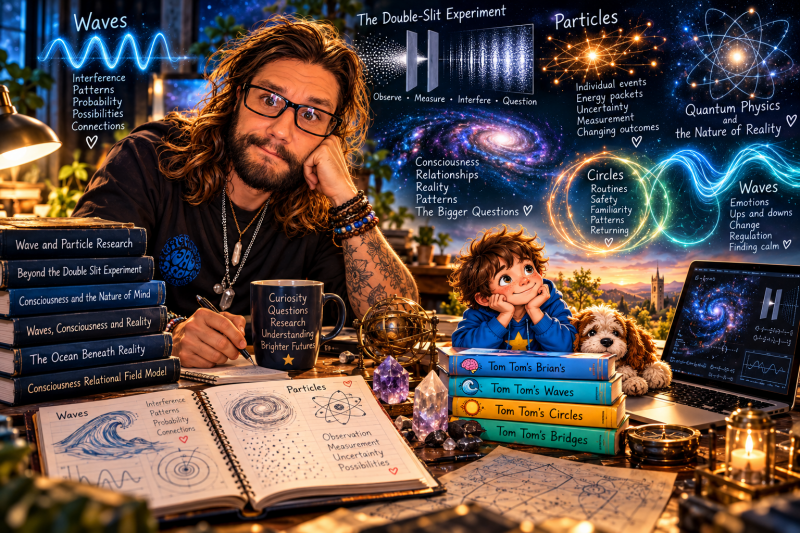
That curiosity has led me to explore waves, particles, probability, measurement, consciousness and the nature of reality. I also write about my own developing ideas, including the Consciousness Relational Field Model. These are personal theoretical explorations, not established scientific conclusions. I aim to distinguish them clearly from the experimentally supported foundations of quantum physics.
I’m also fascinated by patterns such as waves, cycles and circles. In the Tom Tom Universe, Waves help children picture feelings as they rise and settle. Circles represent familiar routines and patterns that can bring comfort and predictability. These are learning metaphors, not claims about quantum physics.
For me, both research and children’s learning begin with curiosity: What happens if? Why does it work that way? What might we discover next?
One curiosity, two worlds: exploring the universe around us and the thoughts and feelings within us.
Counsellor Tomass James Wood — exploring waves, particles, consciousness, neurodivergence and the questions that connect them.
The Wave, the Particle and What Everything Is Made Of
What is everything made of? It’s a question that leads from the objects we can see down to atoms, and then into the strange world of quantum physics.
Atoms make up the matter around us. They contain electrons and a nucleus; the nucleus contains protons and neutrons, which are made of smaller particles called quarks. Electrons and quarks are among the fundamental particles in our current understanding of nature. The Standard Model describes how these particles interact, though it does not answer every question about the universe.
At the quantum scale, particles do not behave simply like tiny solid balls. They can produce wave-like patterns, yet detectors register individual, localised events. In today’s picture of nature, particles can be described as waves in fields that extend through space. Light, for example, can show wave behaviour and also arrive in packets called photons.
This makes me wonder: what do we mean when we call something a particle? What is a wave in this context? And how do these tiny building blocks combine to create the world we experience?
These are questions to explore with curiosity. Some answers are supported by strong experimental evidence; others remain open questions. My research follows that path—from waves and particles to the deeper question of how the universe is put together.
Quantum Physics at Home
Curious young researchers can explore ideas connected to quantum physics using everyday objects and careful observation. This printable notebook guides a star through activities with a coin, water ripples and polarised sunglasses, then helps them choose a question, check a source and record their own findings.
The activities are starting points for learning. They explain clearly that household objects can model ideas such as probability, waves and light, but they do not prove quantum physics.
A thoughtful first step into asking big questions about the world around us.
A Star’s Home Discovery Project
What would you like to learn about next? This free printable guide helps a star turn their curiosity into a home project, from choosing a question and making a plan to researching, creating and sharing what they discover.
It includes practical guidance for adults on offering support while keeping the star’s interests, choices and way of learning at the centre. Projects can be small and can explore any subject.