

Inspiring every young voice to tell their story
Welcome to Tom Tom's Young Writers. Created by Counsellor Tomass J Wood, this space provides children and teenagers aged 7–18—especially neurodivergent thinkers—with creative resources, flexible tools, and the encouragement needed to share their ideas with the world.
Keeping a Journal and Noticing the World
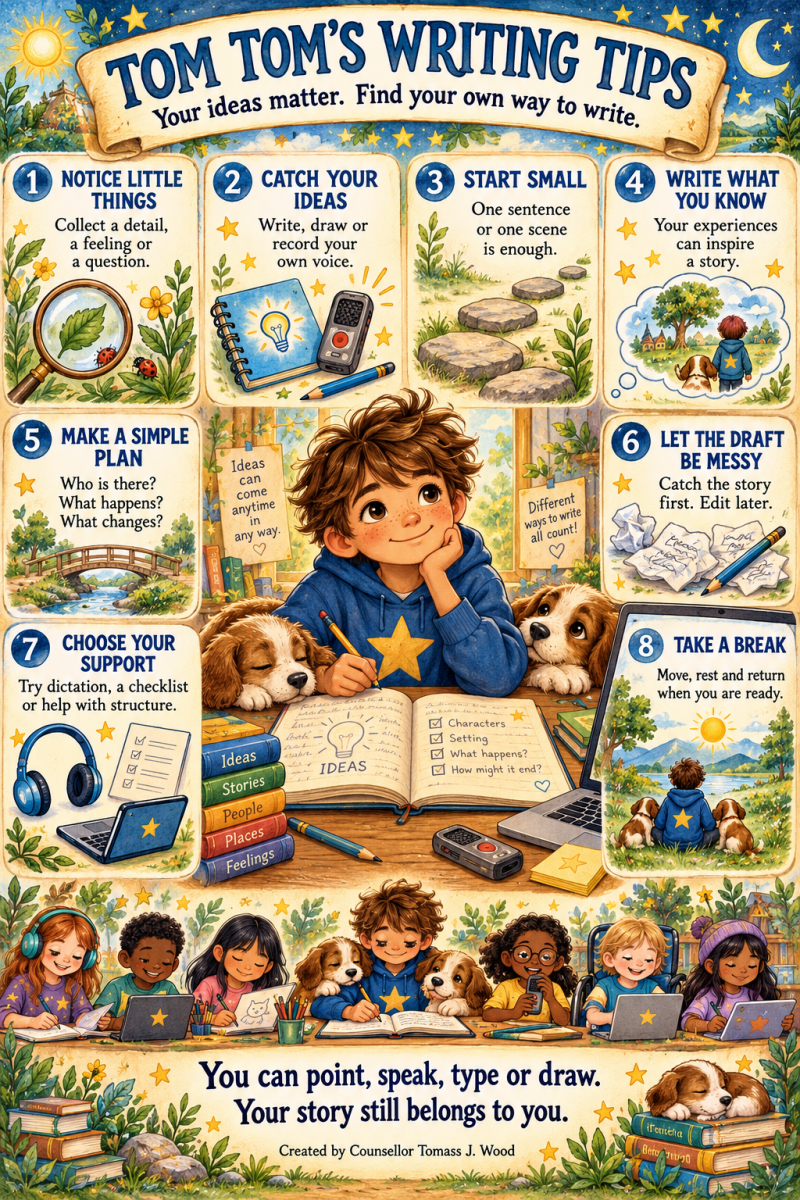
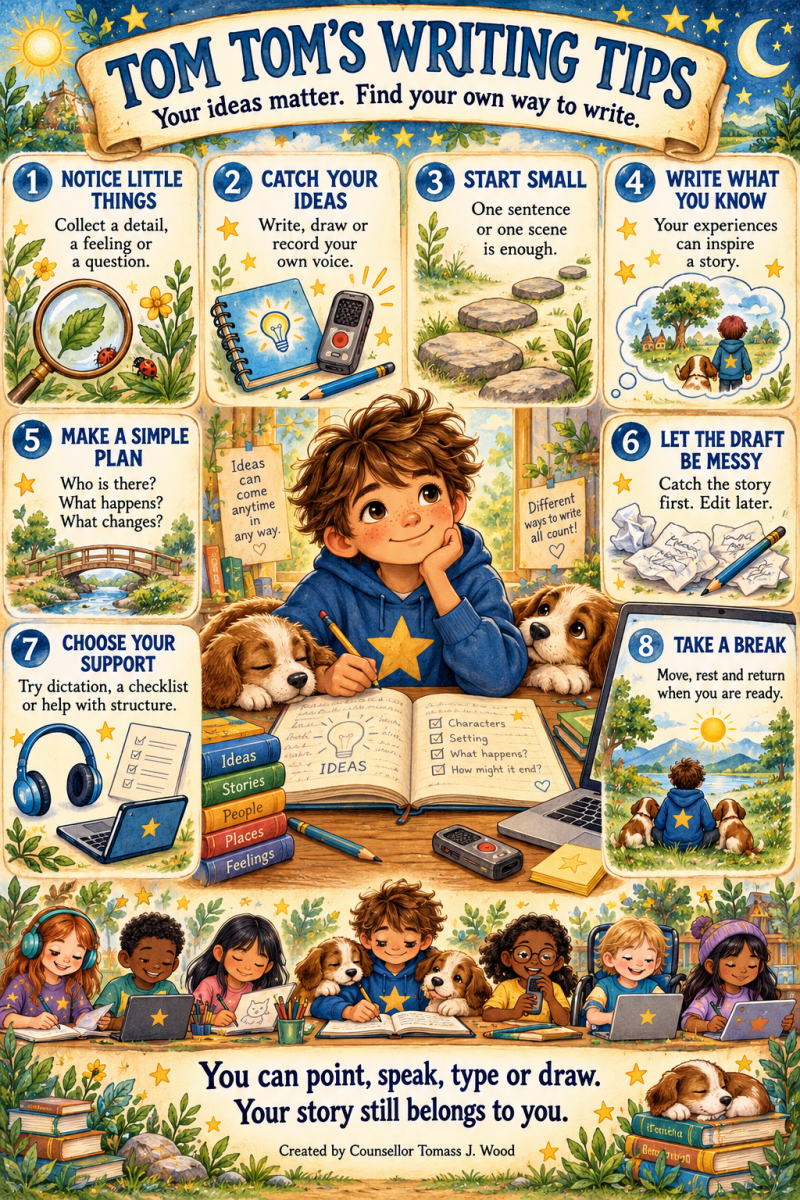
Every writer begins by noticing something. It might be a strange shadow, a conversation, the sound of rain against a window or a feeling they cannot quite explain. You do not need a whole story before you start. A few words can keep an idea safe until you are ready to explore it.
A journal gives those discoveries somewhere to live. Write about your day, record a dream, sketch somewhere interesting or collect questions. Your journal does not have to be tidy, and you do not have to write every day. Spelling and punctuation can wait while you catch the thought.
Notes can be short: “The empty swing kept moving,” or “I felt brave and frightened at the same time.” Those little observations can later become a setting, a character or the beginning of an adventure.
If writing things down feels difficult, try an audio note. Speak your idea aloud, describe what you noticed or tell the scene as though you were sharing it with a friend. Record your own voice and ask permission before recording anyone else. Drawing, photographs and a few key words can help too.
Pay attention to what interests you. What do people do when they are nervous? How does a familiar place change after dark? What small detail would someone else walk past? You can describe sounds, textures, movement or feelings—whatever you notice most.
Try collecting one observation today. It does not have to be clever or important. Writing often grows from giving an ordinary moment a little more attention.
Writing About What You Know and Experience
Your life contains things nobody else has experienced in quite the same way. Your interests, friendships, worries, discoveries and small victories can all give your writing something personal.
Writing about what you know does not mean copying your life exactly. You might borrow the feeling of starting a new school and give it to a character arriving on another planet. A time you felt misunderstood could inspire a mystery. A comforting toy, a favourite tune or a place you remember could become the heart of a story.
Begin with a moment you can remember clearly. What happened? What did you notice? What did you want someone to understand? Details such as a squeaking chair, cold hands or a familiar voice can help a reader feel present in the scene.
You can also write about things you love: animals, music, games, science, sport or an unusual question that keeps returning. Your enthusiasm gives you somewhere to begin. When your story reaches beyond what you know, research and thoughtful questions can help you explore further.
You decide how much of yourself to share. Private writing can stay private, and difficult experiences do not have to become stories before you feel ready. When writing about real people, think carefully about their privacy and ask a trusted grown-up for help before publishing sensitive details.
Your experience does not have to seem extraordinary to matter. Sometimes the most powerful story begins with a small, honest feeling that helps another reader think, “Someone understands.”
Using AI to Help Organise Your Writing
Having plenty of ideas and finding it difficult to organise them can happen together. If you are neurodivergent, some parts of writing may feel exciting while others—planning, spelling, starting or keeping track of a long story—take more effort. Different writers need different kinds of support.
AI can be one tool for working with ideas you have already created. You might give it a few notes and ask it to suggest an order, divide a project into smaller steps or point out where a paragraph becomes confusing. You can also ask for spelling and grammar suggestions while keeping your own voice.
Be specific about the help you want. Try: “Put these notes into a possible chapter plan without adding new events.” Or: “Suggest corrections, but keep my wording wherever possible.” Another useful request is: “Ask me one question at a time so I can develop this character myself.”
Treat its response as a suggestion you can question. AI can misunderstand your meaning, invent information or replace an unusual phrase that you wanted to keep. Read the changes, keep what helps and reject what does not. Save your original draft so you can compare.
Use an age-appropriate service with a trusted grown-up’s guidance, and keep identifying details about yourself and other people out of your prompts. For schoolwork or competitions, follow their rules and explain any AI assistance when required.
You can ask a teacher, friend or family member for the same kinds of support too. The aim is to find a way of working that helps you express your ideas. Your curiosity, choices and experiences remain at the centre of the story.
Support for budding storytellers
We believe every young person has valuable stories inside them. Our writing pathways adapt to your child's individual pace, communication style, and creative strengths.


Competitions and publishing
Find age-appropriate writing competitions and platforms that welcome young submissions, giving children a safe space to share their work and celebrate achievements.
Websites to Help Young Writers Grow and Share Their Work
Your writing does not have to stay in a notebook forever. When you feel ready, you can explore writing communities, enter competitions or submit a story or poem for publication. Start with one opportunity that suits your age and interests. Being selected is never guaranteed, but preparing and sharing a piece can be a worthwhile step.
1. Write the World
For writers aged 13–19, Write the World offers a free writing community, prompts, peer feedback and free monthly competitions. Eligible prompt responses and competition entries can also be considered for its online journal, Write the World Review. A useful place to practise, revise and explore different kinds of writing.
Website: "www.writetheworld.org" (https://www.writetheworld.org/)
2. Young Poets Network
Run by The Poetry Society, Young Poets Network offers poetry inspiration, writing challenges and listings of competitions and publishing opportunities. Its own challenges generally welcome writers aged up to 25, although individual opportunities have their own rules. Some challenges offer publication on the website.
Website: "ypn.poetrysociety.org.uk" (https://ypn.poetrysociety.org.uk/)
3. Foyle Young Poets of the Year Award
A free international poetry competition for ages 11–17, with opportunities for recognition, publication and writing development. The 2026 deadline was 31 July, so that round is closed. Visit the official website for future entry announcements and inspiration from previous winners.
Website: "www.foyleyoungpoets.org" (https://www.foyleyoungpoets.org/)
4. Young Writers
Young Writers runs poetry and creative-writing competitions for different school-age groups. Selected work may appear in its anthologies. Its terms state that entry is free and no purchase is needed to enter or win; books are available to buy separately. Check the age range, publication permissions and rules for the particular competition you choose.
Website: "www.youngwriters.co.uk/competitions" (https://www.youngwriters.co.uk/competitions)
5. Stone Soup
Stone Soup accepts stories, memoir, novels and poems for consideration. Its current submission page welcomes writers aged 18 or younger, requires work in English and asks for a parent or guardian’s involvement. This is a publishing opportunity rather than a guarantee of acceptance.
Website: "stonesoup.com/submit-writing" (https://stonesoup.com/submit-writing/)
6. One Teen Story
One Teen Story runs a free competition for writers aged 13–19, offering publication, payment and the chance for winners to work with an editor. The announced 2027 contest opens on 20 October 2026 and closes on 1 December 2026. It seeks original, unpublished stories of 2,000–4,500 words about the teen experience.
Website: "one-story.com/write/one-teen-story-contest" (https://one-story.com/write/one-teen-story-contest/)
7. Scottish Book Trust
Scottish Book Trust lists writing opportunities and workshops, particularly for young people based in Scotland. Its monthly 50 Word Fiction competition includes categories for ages 5–11 and 12–18. Such a short format can offer a manageable starting point, and winning stories are published online. Follow the links to the current prompt and entry rules.
Website: "Opportunities for young writers" (https://www.scottishbooktrust.com/writing-and-authors/opportunities-for-young-writers)
Before You Submit
Ask a trusted grown-up to help you check the age limits, deadline, word count, any fees and publication permissions. Some opportunities require unpublished work, so check before putting your entry on a public website.
Check AI rules before using AI on a competition piece, including for planning or restructuring. One Teen Story prohibits AI assistance; Stone Soup’s current declaration allows help with spelling and minor grammatical issues but restricts wider assistance. Rules differ between organisations.
If you need help accessing an entry form or preparing your submission, ask the organiser what support is permitted. Keep a copy of your work and submission details. Most importantly, remember that a competition result is one decision about one piece of writing. Your imagination still deserves room to grow.
Website details checked on 5 October 2026. Opportunities and rules can change.
A welcoming space for neurodivergent creators
Traditional writing exercises can sometimes feel rigid or overwhelming. Tom Tom's Young Writers champions neurodiversity by prioritising personal expression over strict perfection, helping young minds build lifelong literacy confidence.

Start small with quick creative sparks
Every journey begins with a spark. Our exercises invite children and teenagers to pick a quick writing tip, describe a single feeling, or invent a scene using whatever medium feels best today. Whether it is two sentences or a full chapter, every effort counts.
Tom Tom’s Writing Tips for Young Neurodivergent Writers
Your ideas matter. You might think in pictures, hear conversations in your imagination or collect more ideas than you can put on a page. You might also find starting, handwriting, spelling or organising a story difficult. You can enjoy writing and need support with it. Different writers need different tools, and you can discover what works for you.
Start with the interesting bit
You do not have to write the beginning first. Start with the mysterious noise, the funny conversation or the character you cannot stop imagining. You can work out where it belongs later.
Catch ideas in your own way
Write a few words, draw a picture, type a note or record yourself speaking. An idea does not need complete sentences to be worth keeping. Choose one place to collect your ideas so they are easier to find again.
Make the task smaller
“Write a story” can feel enormous. Try “name my character”, “describe the room” or “write three lines of conversation”. One manageable step gives you somewhere to begin.
Give your story a simple shape
Ask: Who is here? What do they want? What gets in their way? What happens next? What changes? You can answer with words, drawings or spoken notes. Your plan is allowed to change as you write.
Leave a marker and keep going
If you cannot find a word, put “[word here]” and continue. If you need to check something, write “[check later]”. This helps you keep hold of the story without stopping for every detail.
Separate creating from editing
First, get some ideas down. Later, choose one thing to improve: the order, a confusing sentence or a spelling. You do not have to fix everything at once.
Make your writing space fit you
You might prefer quiet, background sound, a different chair or room to move. Change what you can and ask for support with what you cannot. There is no single correct way to sit and create.
Leave yourself a return note
Before a break, write something like, “Next, Mia opens the strange letter.” That little reminder can make returning easier. A break does not mean you have failed.
Helpful Tools to Try
An idea notebook or notes folder
Keep interesting words, questions, drawings and scene ideas together. Simple labels such as Characters, Places and Story Ideas can help you find things without creating a complicated system.
Voice notes and dictation
A voice note keeps your spoken idea as audio. Dictation turns speech into text. Try either if speaking feels easier than handwriting or typing. Check dictated words afterwards, especially names. Record your own voice and ask permission before recording somebody else.
Sticky notes and story cards
Put one event on each note, then move them around to explore the order. Drawing an event works too. This lets you see the story before writing every sentence.
A small checklist
Try: Choose an idea. Make a few notes. Draft one part. Take a break. Read it again. Keep the checklist short enough to help you begin.
Read-aloud support
Listen to your draft using a text-to-speech feature, read it aloud yourself or ask someone to read it with you. Hearing the words may help you notice where something is missing or unclear.
A comfortable writing tool
Try a pencil, pen, keyboard or stylus that feels manageable. If handwriting hurts or becomes tiring, tell a trusted grown-up and ask about another way to record your work.
AI for organising your own ideas
If an age-appropriate service is available with a trusted grown-up’s guidance, you could ask: “Organise these notes into a possible plan without adding new events,” or “Ask me one question at a time.” Check its suggestions, keep your original draft and leave private information out. Follow school or competition rules about AI assistance.
A patient writing partner
A teacher, friend or family member can listen, help you sort notes or write down words you dictate. Tell them what help you want: “Please help me organise this, but let me choose what happens.”
You do not need every tool. Try one that makes a difficult part easier. Your questions, experiences and imagination are worth making room for—and your story can grow one small piece at a time.
Connect, create, and share
We invite parents, carers, and educators to explore our supportive resources, discover free learning materials, and get in touch to find out how Tom Tom's universe can inspire the young writers in their care.
